FAQ

HydroWork GmbH

Your questions – our answers

National and international construction companies rely on our expertise in tunnel construction.
We have been providing professional and industrial diving services to engineering firms and municipal agencies for over 14 years.
Both HydroWork and our certified and qualified staff meet all government and occupational safety requirements. We provide both personnel and equipment and are available on short notice.
We have answered many of your questions about our diving and compressed air operations:

FAQ Compressed air work

The international crew of HydroWork GmbH has extensive practical experience in carrying out a wide variety of tasks in overpressure, underground on tunnel construction sites; even at high pressures.

  • Worldwide support of tunnelling projects with specially trained personnel for any overpressure work
  • Provision, design and construction of personnel and patient locks
  • Customer-specific equipment of mobile treatment chambers
  • Medical chamber maintenance
  • Maintenance, refurbishment, and equipping of existing airlocks for personnel in tunneling
  • Provision of mobile oxygen systems
  • Provision of technology and first aid accessories
  • Provision and delivery of equipment for work in overpressure
  • Training courses

Our Equipment
We provide the right equipment for every project. Of course, our hyperbaric tunnel workers are equipped with state-of-the-art equipment. HydroWork also has the appropriate equipment to suit the customer’s requirements

All employees are qualified and have operational experience and can show current medical compressed air examinations. Our crew includes:

  • Compressed air supervisors with a certificate of competence in accordance with the Compressed Air Ordinance (Hyperbaric Supervisors)
  • Lock keepers and lock operators
  • Compressed air technicians (Hyperbaric Technicians)
  • Compressed air technicians for MixGas applications
  • Diving work in bentonite
  • Tunnelling personnel for TBM (tunnel boring machine) and AVM (overburden boring machine)
  • Cutting wheel cleaning on the tunnel boring machine (TBM)
  • Changing the cutting wheel tools of the TBM
  • Welding work on the cutting wheel
  • Diving in Bentonite
  • Working with mixed gas at high pressures

Read more about our tunneling support

Our equipment
We supply special equipment for all underground work in compressed air worldwide:

  • Mobile medical/ pressure chambers:
    • 40-foot container hyperbaric chambers (up to 6 places in main chamber, 2 in antechamber including doctor’s room)
    • 20-foot Container pressure chambers (Mobile Medical Chamber)
    • Hyperbaric chamber with round doors in a 20-foot container
  • Oxygen emergency kit
  • Oxygen Sensors
  • Mobile Respiratory Oxygen System MSS 100
  • Mobile breathing system for welding work
  • Renovation of TBM locks
  • Saturation systems
  • Fire extinguishing systems
  • Safe diving work in bentonite
  • All diving equipment


We have projects in Germany, Europe, America and Asia. HydroWork is equipped for operations worldwide.

Are you interested in our previous tunnelling projects? On our homepage you will find a world map with our previous locations.

In tunnel construction, the working area in front of the machine is pressurized to create a counterpressure against soil and water pressure. This improves the stability of the tunnel face and reduces the inflow of groundwater.

How is compressed air generated?
Compressed air is generated by compressors that suck in air and reduce its volume. The pressure increases according to the physical relationship between volume and pressure.

Working under hyperbaric pressure means that people are in an environment where the ambient pressure is above atmospheric pressure. This requires special safety and decompression procedures.

Who is allowed to carry out compressed air work?
This special work may only be carried out by qualified and certified personnel. Staff must meet certain requirements and undergo regular occupational health check-ups. For example, G31 suitability (working under overpressure) is required. This certificate confirms that the persons are medically suitable for such activities. They also have recognised training and relevant experience, for example in the field of professional diving

There is a special and obligatory hierarchy for an optimal organization of compressed air work:

  • The compressed air Supervisor. He is the reference person for the customer, colleague and doctor; he organizes everything related to compressed air as well as the commissioning and maintenance of the compressed air technology required on site
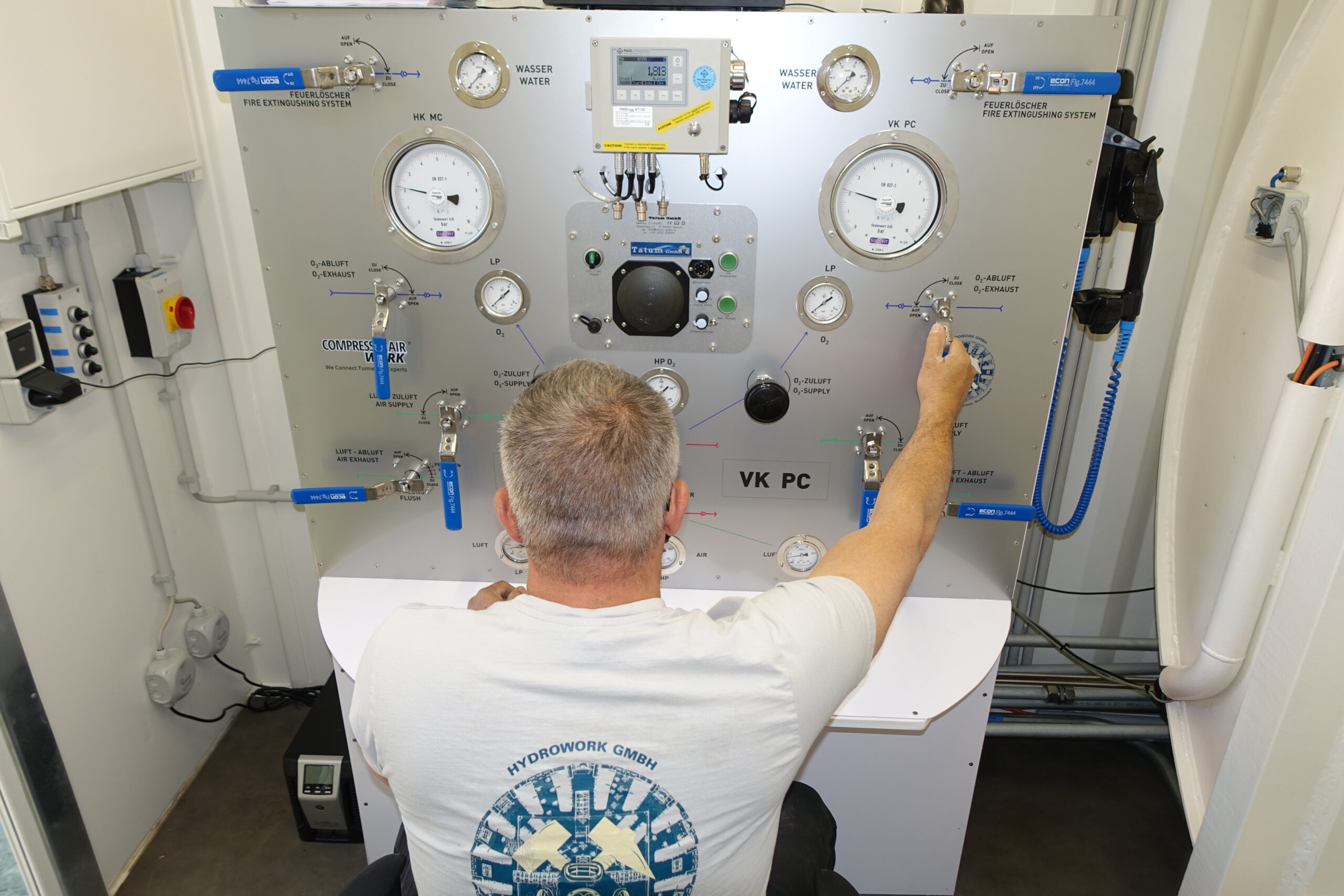
  • The Lock Operator. He is the person in charge of controlling the Working Chamber, where people are channelled in and out, assisting the pneumatic workers and keeping in constant contact with them through a communication system.
  • The Hyperbaric Tunnel Worker . They work in the compressed air environment at the TBM (tunnel boring machine). Their work consists of TBM sanitation and maintenance.
    They are responsible for the TBM cutting tools (repair, maintenance, spare parts). Normally, three compressed air workers are employed per shift. Three people in case something unexpected happens, such as an injury or fall, and then the other colleagues can help quickly.


The main risks include

  • decompression sickness
  • physiological stress due to increased gas partial pressures

These risks require controlled pressure profiles and medical monitoring. To avoid risk, there are legal requirements.

A hyperbaric chamber is a pressure-tight system designed to treat decompression sickness. It is mainly used to treat decompression accidents.

A medical hyperbaric chamber must be accessible within 30 minutes and available 24/7.
It is the only system to deal with sudden health emergencies in the compressed air environment. It has specific requirements and it is managed by the supervisor or another smuggler keeper in COLLABORATION with the medical staff.

This process usually takes only a few minutes. However, the exact duration depends on the individual sensitivity of the pneumatic workers. In most cases, a few minutes are enough to perform the compression safely.

Does the same time principle apply to the decompression phase?
No! The decompression phase is much more complex and takes considerably longer. During this phase, the lock operator closely monitors every minute. Various pressure levels and time intervals must be strictly adhered to. Everything depends on the working pressure and the duration of the stay under pressure. In most cases, the supply of oxygen—provided by a portable oxygen unit—also plays a crucial role.

How are the pressure levels controlled in the decompression phase?
There are special tables that determine the duration of the decompression phase based on the working pressure and the length of stay under pressure.

These tables are drawn up by a specialist doctor as part of the risk assessment. They are regulated by special institutions. In Germany, for example, they are set by the BG Bau. There are also American and French tables, which are very well known and are used worldwide.

  • Only from a working pressure above 4,5 bar is a saturation system appropriate.
  • Definition: A saturation system, also known as a saturation system, is a containerized system for tunneling that functions as a complete self-supporting unit. The saturation system is independent of other systems
  • The TBM (tunnel boring machine) must be suitable for docking the transport shuttle (see below)
  • HydroWork designs custom-made, customer-specific saturation systems
  • Container of a saturation system.
    As a rule, a saturation system consists of:

    • a living chamber
    • a control container
    • Equipment/Storage-Container
    • Gas storage-Container
    • Medical Chamber
    • Hyperbaric transport shuttle to transport compressed air personnel from the living area directly to the TBM without pressure change

Read more about the saturation system

The oxygen system is mandatory during the decompression phase in the hyperbaric chamber. Inhalation of oxygen is necessary to avoid decompression sickness.

FAQ Diving work

HydroWork offers all types of diving work in every type of water:

  • Any work on power plants and reservoirs, from inspection and setting of dam panels to repair and maintenance.
  • Underwater welding and flame cutting regardless of visibility
  • Removal of underwater concrete by means of high-pressure water jets up to 2,500 bar
  • Vorbereitung und Durchführung von Unterwasserbetonagen einschließlich aller erforderlichen Nebenleistungen
  • Preparation and implementation of underwater concreting including all necessary services
  • Underwater detection and recovery of objects (e.g. construction equipment, boats, etc.) as well as support for authorities
  • Installation, maintenance and repair of subsea equipment
  • Vacuuming and cleaning segments in construction pits, ponds and lakes
  • Underwater coatings with synthetic resin
  • Surveying and documentation by means of drone inspection

Our diving vehicles and the diving equipment used are equipped with modern video systems. In addition, we use underwater drones if necessary . This allows us to transmit live video recordings in real time during inspections and record them for later analysis and documentation.

Furthermore, we provide emergency decompression chambers on site for particularly deep dives with decompression times of over 35 minutes, as well as for high-risk operations or at remote locations; this is done in accordance with the specifications of the employers’ liability insurance association.

With our wide range of pneumatic and hydraulic tools, we carry out a wide range of underwater work from core hole drilling to cutting and spreading work to the use of hydraulic chainsaws.

Read more on our diving work

The professional divers of HydroWork GmbH work with state-of-the-art equipment and go into all kinds of waters:

  • Diving work in contaminated water such as wastewater dives in sewage treatment plants and on tunnel construction sites at overpressure in bentonite. Our trained divers are equipped with specialized industry standard diving systems from commercial dive equipment manufacturers (e.g. the Tatum helmet approved for this purpose)
  • Diving services at hydroelectric power plants, fossil fuel power plants, dams, locks and weirs: underwater suction and flushing work necessary for the installation of dam boards, as well as repair, maintenance and documentation of structures
  • Underwater inspection for pipelines / fiber optic cables / power cables: installation, repair (even in emergencies) and maintenance of your underwater cables.
  • Offshore/Wind: Subsea solutions for wind turbines and the oil and gas industry: first-class technology and highly skilled divers

We provide the right equipment for every project. Of course, our divers are equipped with state-of-the-art equipment. As a company, we carry out our operations exclusively with surface-supplied diving systems. Among other things, diving helmets from Kirby Morgan and Tatum will be used. Our Tatum helmet is specially approved for use in contaminated water as well as for diving operations in bentonite when working in overpressure on TBMs (tunnel boring machines) especially at tunnel construction sites. Furthermore, we have a large number of fixed dome pontoons, which can be built individually or combined to form large and stable working platforms, also for the use of lifting equipment.

Our Equipment:

  • Dome pontoons incl. delivery/delivery
  • Hydraulic Core Hole Drilling Machines
  • Hydraulic Drilling Machine
  • Hydraulic cut-off grinders
  • Hydraulic chisel hammers
  • Hydraulic chain saws
  • High-pressure systems for cleaning from 50 to 500 bar
  • High-pressure systems for removing concrete up to 2,500 bar
  • Wide range of suction and mud pumps
  • Underwater Burning & Welding Equipment
  • Submersible pump
  • Underwater color video camera / underwater photo / video system
  • Underwater drone

For details, see also BGV C23, the accident prevention regulation for diving work of the BG Bau.
A risk assessment has been conducted

  • The equipment is suitable
  • The staff is qualified, i.e. a completed training as a professional diver and health suitability. The safety of diving operations also includes:
  • Sufficient, safe and redundant breathing gas supply
  • Suitable means of communication between diver and surface: Constant voice connection or sign alone
  • Emergency and rescue facilities are available: rescue equipment, first aid, hyperbaric chamber if necessary
  • In case of poor visibility or current, additional safety measures and reduced working methods are required

A full group of divers has a diver, safety diver, dive guide and signalman.
The safety diver must be ready for action and fully equipped at all times.

According to BGV C23, § 15, diving logs must be kept and the operations documented.

The working hours for the diver are regulated by the diving table of BGV C23.
The total time may be shorter due to temperature or personal needs.

The equipment used for the use of diving work is described in BGV C23 as well as the references to maintenance in repair.

Fragen zum Thema FAQ?

Zögern Sie nicht, sich mit Ihrem Projekt und ihren Fragen zum Thema FAQ direkt an uns zu wenden. Gerne stehen wir Ihnen beratend zur Seite und besprechen Ihre Möglichkeiten.

HydroWork GmbH

Am Handwerkerhof 13
85399 Hallbergmoos

Contact us
Privacy policy